What Does the Future Hold? How Jensen Huang's Carnegie Mellon Speech Redefines Our Path in the AI Era
What is the single most important message for graduates entering a world forever changed by artificial intelligence? Why does the founder of the world’s most valuable chip company choose a commencement stage to deliver a wake-up call about the nature of work and innovation? How can we, as individuals and businesses, not just survive but thrive in this new digital frontier? These are the questions at the heart of NVIDIA CEO Jensen Huang’s powerful commencement address at Carnegie Mellon University (CMU)—a speech that transcends typical graduation platitudes to offer a concrete blueprint for the future of business and humanity.
In May 2024, Huang stood before CMU’s graduating class not just to celebrate their academic achievements, but to challenge their very understanding of what it means to be an entrepreneur, an engineer, or a leader. His address, which has since become a cornerstone of modern tech discourse, is not merely about the technology of AI; it is about the human response to this technology. This article will dissect that speech, exploring its implications for digital transformation, business AI, and the automation of our work and lives. We will move beyond the headlines to understand the deep, structural shifts Huang is predicting and how to apply his wisdom today.
Section 1: The Great Reset – Why AI Is Not Just Another Tech Wave
Deep Explanation: The 'iPhone Moment' for Every Industry
Jensen Huang began his CMU address by framing the current moment in history not as an incremental step forward, but as a complete restructuring of the computing stack. He argued that we are experiencing the 'iPhone moment' of AI—a singular event that redefines the user interface and the underlying infrastructure of all digital life. For decades, computing was about retrieving data from structured databases. You typed a query, and the machine gave you a result. AI, specifically generative AI, inverts this model. It creates new data, new solutions, and new pathways in real time.
This is not just an upgrade; it is a paradigm shift. For businesses, this means the end of traditional software as we know it. Every application, from customer service chatbots to complex data analytics, will be rebuilt with a 'reasoning engine' at its core. Huang emphasized that the fundamental skill of the future is not coding per se, but the ability to decompose complex problems into smaller, logical steps that an AI can then execute. This is a profound change in how work is structured. It moves the value of a human worker from raw execution to high-level strategy and problem definition.
Real-World Application: The Manufacturing Floor
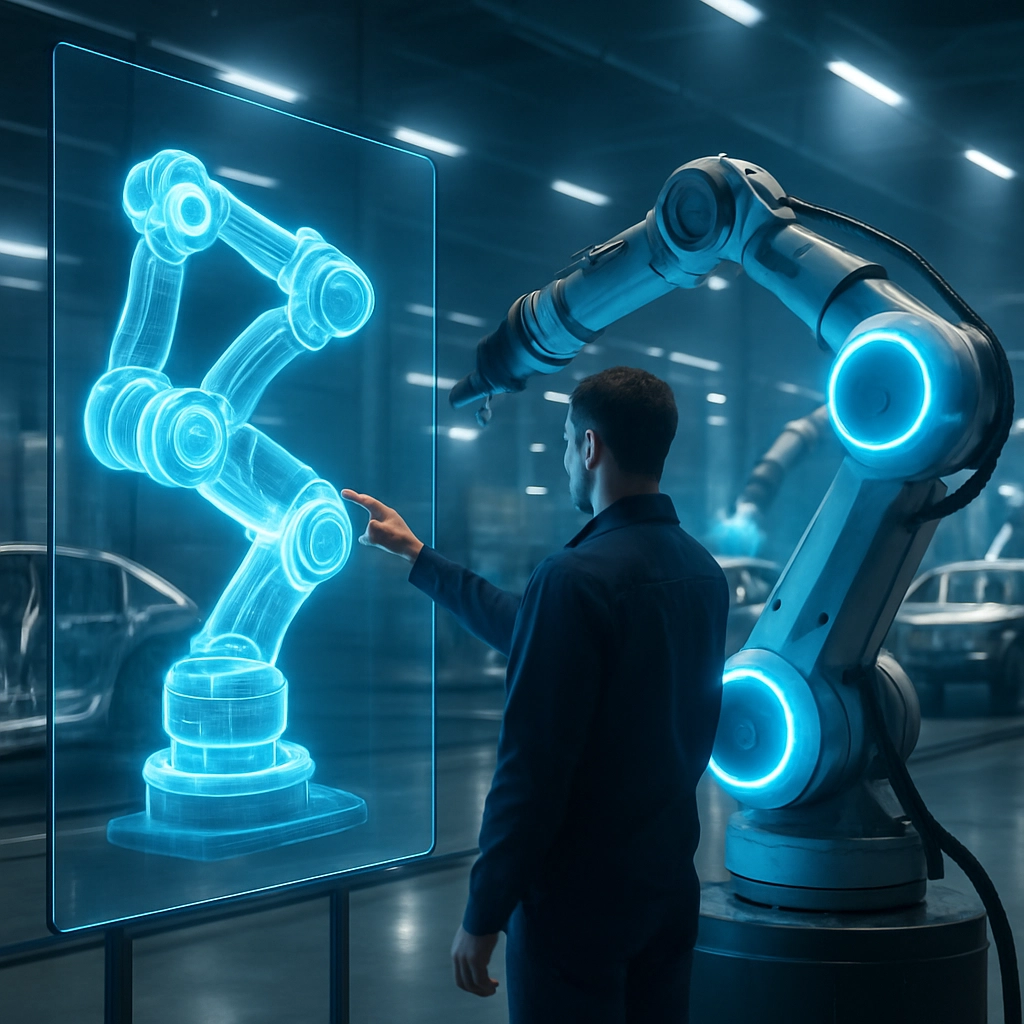
Consider a modern automotive factory. Previously, a manufacturing engineer would spend weeks writing precise code to program a robotic arm for a new car model. Using the principles Huang outlined, the engineer now acts as a supervisor of AI agents. They describe the desired outcome in natural language (e.g., 'Weld the chassis with zero variance in these three specific locations'), and an AI system trained on millions of previous welds generates the optimal robotic movement and force parameters. The 'programming' becomes a dialogue of intent. This not only speeds up production by 10x but also allows for hyper-customization. The same assembly line can switch between different car models in minutes without physical re-tooling, simply by changing the prompt. This is digital transformation realized at the atomic level of physical industry.
Section 2: The New Superpower – How to Think Like an Engineer of the Mind
Deep Explanation: Decomposition as the Core Skill
One of the most striking segments of Huang’s address was his deep dive into the art of problem decomposition. He argued that in a world where AI can write code, generate reports, and design circuits, the limiting factor is no longer the ability to compute, but the ability to formulate the question. He drew a direct line from this concept to the ancient Greek method of Socratic reasoning: break a big, impossible problem into a sequence of smaller, solvable ones.
This is the essence of prompt engineering on a grand scale. Huang challenged the graduates, and by extension all of us, to become 'engineers of the mind.' This skill set transcends technical knowledge. A biologist who can decompose a genetic problem into testable hypotheses that an AI can then simulate is more valuable than a coder who cannot. A marketing executive who can break a branding challenge into segments of audience emotion, cultural context, and data trends is leading the transformation. Huang essentially redefined business AI from a tool we use to a partner we instruct.
Real-World Application: Drug Discovery
Let’s look at the pharmaceutical industry. A traditional research team might spend a decade trying to discover a new drug molecule. Applying Huang’s philosophy, a team today works like this: The lead scientist does not start by writing code to simulate billions of molecules. Instead, they decompose the problem. Step 1: Identify the exact protein structure of the disease target. Step 2: Define the chemical 'rules' for a molecule to bind to that protein. Step 3: Have an AI agent generate 10,000 molecules that meet those rules. Step 4: Send those candidates to a second AI agent that simulates their toxicity. Step 5: Human experts review the top 10 candidates. The scientist acts as the system architect, not a manual laborer. This reduces a decade of work to months, directly impacting the speed of digital transformation in healthcare.
Section 3: The Ugly Truth – Why 'Hard Work' Will Harm You Without AI
Deep Explanation: Reframing the Protestant Work Ethic
Jensen Huang delivered a stark warning that is often missed in the hype around AI. He suggested that the traditional virtue of 'hard work'—the willingness to grind for 80 hours a week—is a trap if applied without intelligence. In an AI-driven world, manual toil that could be automated is not just inefficient; it is destructive to your career and your company. He urged the graduates to never do work that can be done by a machine, not because they are lazy, but because they are valuable.
This redefines the concept of automation. For decades, automation was about replacing humans in rote, dangerous, or dull jobs. Huang’s message is that automation must now apply to knowledge work. If a junior analyst spends 10 hours a day formatting data into spreadsheets, they are not building their career; they are wasting their cognitive potential. The 'hard work' that matters now is the hard work of strategic thinking—the painful, lonely process of deciding what the machine should do, not how to do it. This is the new scarcity in the labor market: the ability to make high-stakes decisions.
Real-World Application: The Role of the Accountant
Consider a traditional accounting firm. The old model hires dozens of junior accountants to manually verify thousands of transactions. If a partner at that firm refuses to adopt AI tools, they become a commodity. Their 'hard work' is simply cheaper than the AI, but not better. A modern accounting firm, guided by Huang's philosophy, will integrate business AI to handle data reconciliation and anomaly detection. The human accountants are then liberated to do 'hard work' of a different kind: advising clients on tax strategy, detecting financial fraud patterns, and building relationships. The firm that fails to automate will be outcompeted on price and value, regardless of how many hours their staff works.

Section 4: The Infrastructure of Intelligence – How to Build for the Future
Deep Explanation: Your Company Must Become an AI Company
Huang’s address to CMU was not just directed at individual graduates. It was a manifesto for corporations. He stated unequivocally that every company, from a car manufacturer to a real estate agency, must fundamentally transform into an 'AI company' or face irrelevance. This does not mean every firm needs to build its own supercomputer, but it means every firm must learn how to infuse intelligence into its core processes.
He compared this to the advent of electricity. When electricity became widespread, factories did not just plug in their old steam engines. They had to be redesigned entirely—rebuilt for the power of electric motors. Similarly, businesses today cannot simply 'add' AI to their old workflow. They must rethink their entire digital transformation strategy. A hospital cannot just use AI to read X-rays faster; it must redesign the patient journey so that AI handles initial triage, scheduling, and data gathering, allowing the doctor to focus solely on diagnosis and empathy. This is a systemic change, not a technological patch.
Real-World Application: The Real Estate Revolution
Let’s apply this to the real estate industry. A traditional realtor spends 70% of their time on administrative tasks: scheduling viewings, writing property descriptions, analyzing market comps. Under Huang’s model, a real estate firm becomes an AI platform. An AI agent handles all the scheduling and sends hyper-personalized property recommendations based on a client's behavioral data. Another AI agent generates 3D virtual tours and optimizes pricing in real time based on market fluctuations. The human agent’s role transforms into a trusted advisor. They are paid for their negotiation skills, their local market wisdom, and their ability to handle the emotional complexity of a family buying a home. The firm’s value is not in its database of listings, but in its AI-driven ability to match human desire with physical space. This is website optimization taken to the next level—where the entire business model is the website, powered by intelligence.
Section 5: The Core Message – You Are Not Late; You Are Right on Time
Deep Explanation: The Infinity of Opportunity
In the final stretch of his speech, Jensen Huang addressed the profound anxiety of the graduating class. Many feel they are entering a world where the biggest breakthroughs (the internet, mobile, AI) have already been made. He dismissed this fear with a powerful statement: “You are right on time.” He argued that the age of AI is still in its infancy. The infrastructure is being built now—the data centers, the foundational models, the tools. The era of application is just beginning.
He compared the current state of AI to the late 1990s internet. Back then, we had the network, but no Google, no Amazon, no social media. The value creation was still 99% ahead of us. Huang believes the same is true for AI. The raw computing power is here, but the killer applications—the ones that will change how we learn, heal, and connect—are yet to be written. This is the ultimate call to action. It is a challenge to look at a world that seems saturated with technology and see instead a blank canvas. The opportunity is not in doing what others have done, but in using these new tools to automate the mundane and amplify the uniquely human skills of creativity, reasoning, and empathy.

Conclusion: The New Requirement for Humanity
Jensen Huang’s commencement address at Carnegie Mellon was far more than a motivational speech. It was a strategic document for the next decade. It reframed the concept of work from execution to design, from labor to architecture. The single greatest takeaway for business leaders, entrepreneurs, and professionals is this: The future belongs not to those who can work the hardest, but to those who can think the smartest—specifically, about how to leverage AI.
He challenged us to decompose our problems, automate our drudgery, and rebuild our organizations. Whether you are in real estate, healthcare, manufacturing, or services, the fundamental rule is the same. If you are doing work that a machine can do, you are making a strategic error. The value of a human in the age of AI is not in their speed, but in their judgment. As we move forward, the most valuable asset a company can own is not its data or its code, but its people's ability to ask the right questions. The AI revolution is not about machines taking over; it is about humans finally being free to do what they do best: think, imagine, and care.