
Meta's New Playbook: Monetizing Excess AI Compute, the SpaceX Way
What happens when a company builds a supercomputer so powerful that it has more processing capacity than it knows what to do with? How can a social media giant pivot to become a critical infrastructure provider for the next generation of artificial intelligence? And why is a strategy pioneered by SpaceX, a company known for rockets and satellites, now guiding the cloud computing ambitions of Meta? These are the central questions driving a significant strategic shift as Meta looks to turn its massive investment in AI hardware into a new revenue stream, directly challenging the established giants of the cloud computing market.
The core of this strategy is simple in concept but complex in execution: treat excess AI compute like a valuable commodity and sell it to external customers. This move, reminiscent of SpaceX's approach to commercializing its rocket launches, represents a maturation of the AI industry. It signals a shift from a land-grab phase, where companies hoarded chips to train their own models, to a utility phase, where computing power is offered as a service. For Meta, this is not just about recouping investment; it's about building a new, resilient business model that leverages its existing infrastructure to its fullest potential.
The Infrastructure Imperative: From Social Network to Computing Backbone
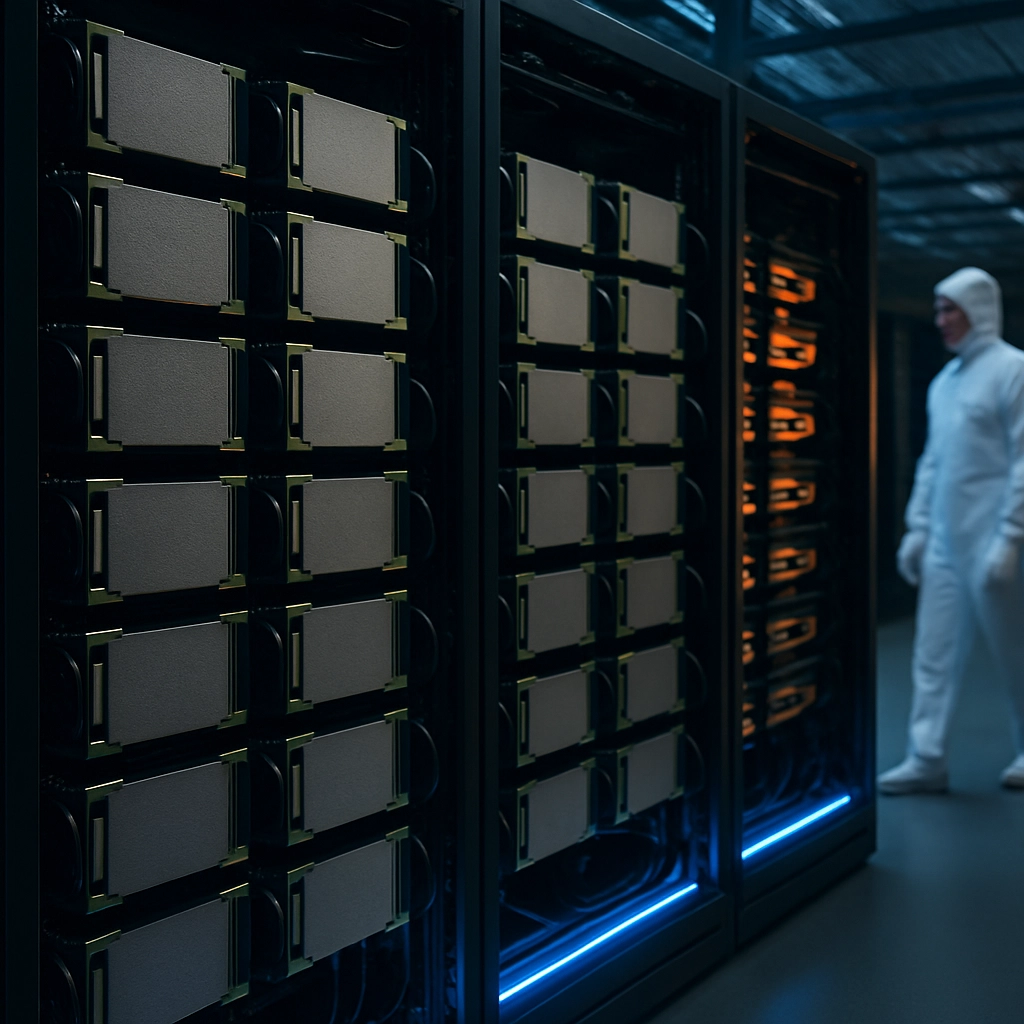
To truly understand this move, one must first recognize the sheer scale of Meta's current infrastructure. Over the past few years, Meta has invested tens of billions of dollars into building out its AI capabilities, primarily to power its recommendation algorithms, content ranking, and the development of its own large language models (LLMs), like the Llama series. This has led to the construction of sprawling, hyper-scale data centers filled with tens of thousands of expensive GPUs, specifically NVIDIA's H100s and the newer, even more powerful Blackwell chips.
The problem, or rather the opportunity, lies in the cyclical nature of AI workloads. Training a new frontier model requires a colossal burst of computational power for weeks or months. However, once the training is complete, the same infrastructure is used for inference—the process of running the model to generate responses for users. Inference workloads are more continuous and steady, but they don't always utilize 100% of the available compute capacity. This leaves periods, sometimes substantial, where these invaluable chips are sitting idle. Every second an expensive GPU is idle is a second it isn't generating value, making efficiency a primary concern.
This is where the SpaceX analogy becomes particularly apt. Just as SpaceX recognized that it had excess rocket launch capacity and began offering rideshare missions to smaller satellite companies, Meta is recognizing that it has excess AI capacity that can be rented out. Instead of letting these chips sit in standby mode, Meta can offer them to startups, research institutions, and even competitors who need the power to train their own models but cannot afford the multi-million dollar investment in hardware. It's a shift from seeing AI infrastructure as a purely internal cost center to seeing it as a potential profit center.
Disrupting the Cloud Oligopoly: A New Competitive Landscape
The current cloud computing market for AI is dominated by three major players: Amazon Web Services (AWS), Microsoft Azure, and Google Cloud Platform (GCP). Each of these has spent years building robust ecosystems, offering not just raw compute but also a vast array of managed services, from databases to pre-trained model APIs. For a long time, customers looking for AI compute had little choice but to go to these hyperscalers. Meta's entry into this space changes the dynamics profoundly.
Unlike the big three, Meta is starting from a different vantage point. It is not simply a cloud provider; it is a creator of models, a social platform, and an owner of unprecedented amounts of open-source AI technology. This gives Meta a unique differentiation in the market. First and foremost, it can offer its own family of Llama models as a fully managed service on its compute platform. This would be a massive draw for companies that want to use Llama but lack the technical expertise to deploy and scale it themselves. This creates a vertically integrated offering where Meta provides both the 'software' (the model) and the 'hardware' (the compute) under one roof.
Furthermore, pricing will be a major battleground. By leveraging its existing scale and infrastructure, Meta could undercut AWS and Azure on price for bare-metal GPU instances. Since Meta already owns and operates these data centers for its own use, it can treat the external sales as incremental revenue, allowing for more aggressive pricing strategies. While this might put pressure on profit margins in the short term, it could severely disrupt the pricing models of competitors, forcing them to become more efficient or specialize in higher-level services to maintain their premium status. This competition is ultimately beneficial for consumers, leading to a drastic decrease in the cost of training and running cutting-edge AI.
Navigating Choppy Waters: Challenges and Strategic Roadblocks
While the potential rewards are enormous, Meta's ambitious plan is not without its significant challenges. The most immediate hurdle is the technical complexity of offering a reliable, secure, and multi-tenant cloud service. Meta's data centers are engineered for its own monolithic workloads, not necessarily for servicing thousands of different external clients with diverse networking and security requirements. Building a robust control plane, implementing virtual private clouds (VPCs), and ensuring strong isolation between tenants is a monumental engineering task that takes years to perfect—a domain where AWS has a massive head start.
Another critical issue is the fairness and internal prioritization of compute resources. Meta's core business is its apps, and those apps must never experience a compute shortage because an external client is running a massive training job. This creates a complex scheduling problem where Meta must guarantee that its internal needs are always met while simultaneously maximizing the utilization of idle resources. A failure to manage this could lead to internal slowdowns or external client outrage if their jobs are preempted. The company will need to develop sophisticated dynamic resource allocation systems to manage this, which is a difficult engineering challenge in itself.
There is also a significant reputational and security risk. If Meta's cloud is compromised, it could expose not only its own user data but also that of every client using its services. In the current geopolitical climate, AI is a sensitive technology. Selling compute to certain foreign entities could invite scrutiny and regulatory backlash. However, if it can pull this off, the potential payoff is enormous, as outlined in a recent article on the subject. The strategic alignment between internal efficiency and external monetization is a powerful triple-win scenario, fostering growth in the wider AI ecosystem while solidifying Meta's position at the center of the industry.

Real-World Applications: Who Will Be the First Customers?
The potential customer base for Meta's AI compute is diverse and hungry for resources. The most obvious candidates are AI startups in the 'model training' space. These companies often have revolutionary algorithms but lack the capital to build their own computing clusters. For example, consider a small team of researchers working on a new generative video model. Renting compute from Meta provides them with the power to train their models without the upfront cost of purchasing million-dollar hardware, allowing them to compete with larger, better-funded labs.
Another major segment is the academic and research community. Universities often have brilliant computer science departments but limited IT budgets. The ability to rent time on Meta's vast GPU clusters on demand could accelerate research in areas like protein folding, climate modeling, and materials science, which rely heavily on AI models. By democratizing access to high-performance computing, Meta could contribute to significant scientific breakthroughs that benefit all of humanity, not just its shareholders.
Finally, there are enterprise companies that want to leverage AI but have strict data residency and security requirements. For example, a healthcare company might want to fine-tune an Llama model on its private patient data to improve diagnosis accuracy but cannot use a public, shared cloud for fear of data leaks. Meta could offer dedicated, single-tenant compute instances within its data centers, providing the necessary security guarantees. This moves Meta from simply being a social media platform to being a foundational technology provider, enabling businesses in all sectors to integrate AI into their core operations safely and efficiently.
The Looming Regulatory Scrutiny and the Future of AI Co-optation
As with any move by a tech giant into a new dominant market position, regulatory scrutiny is inevitable. Meta's foray into cloud computing raises concerns about anti-competitive behavior. Regulators, particularly in Europe and the US, are already wary of Meta's dominance in social media. By also becoming a major player in the AI infrastructure layer, Meta could exert an immense amount of control over the entire AI value chain. They could, in theory, favor their own models on their infrastructure or use their insights from customer workloads to inform their own product development, creating an unfair advantage.
Furthermore, there is the matter of self-preferencing. If Meta offers its own AI services and also provides the compute for competitors to those services, there is a clear conflict of interest. To mitigate this, Meta will likely need to establish clear 'Chinese walls' between its cloud business and its consumer AI business. They will need to sign consent decrees or create internal governance structures that ensure fair treatment of all clients. The European Union's Digital Markets Act (DMA) is already looking at how to regulate core platform services, and cloud computing for AI could be added to the list of 'gatekeeper' services that face strict operational requirements.
Looking forward, the success of this endeavor will define the next decade of Meta. It represents a maturation of the AI boom, moving away from hype and towards sustainable, monetized infrastructure. This move could be the catalyst that makes AI truly ubiquitous, just as the commercialization of cloud computing made websites ubiquitous in the 2000s. It signals the end of the era where AI expertise is the sole differentiator and the beginning of an era where access to computation is a utility. For now, the rest of the industry will be watching closely to see if Meta can successfully emulate SpaceX and turn its massive, expensive engines of innovation into a reliable machine that prints money. The strategy is bold, the challenges are immense, but the potential to reshape the digital landscape is undeniable.

Conclusion: A New Era of Efficiency
Meta's decision to monetize its excess AI compute is far more than a simple business strategy; it is an acknowledgment that we are entering a new phase of the artificial intelligence revolution. The era of endless, unchecked scaling is giving way to an era of efficiency and practicality. By mimicking SpaceX's ability to sell excess capacity on its rideshare missions, Meta is demonstrating a sophisticated understanding of capital-intensive industries. It is applying a classic industrial playbook to the digital world, ensuring that its billions of dollars in assets work not just for its own advertising business, but also for the global AI ecosystem. This strategy promises to lower the barrier to entry for AI innovation, foster intense competition in the cloud market, and ultimately speed up the development of transformative technologies. The question now is not whether this will disrupt the market, but rather, who among its rivals will be forced to adapt first, and how the regulators will react to the consolidation of such immense digital power in the hands of a single company.