The Opportunity at Home: Can AI Drive Innovation in Personal Assistant Devices and Sign Language?
What if the most transformative technology of our time wasn’t a new smartphone, but a device that could finally bridge the communication gap for millions? Why, in an era of unprecedented digital connectivity, are deaf and hard-of-hearing individuals still facing significant barriers in their own homes? And how can the silent language of signs, rich with nuance and expression, be understood by the very machines we invite into our living rooms? These questions are not just technical curiosities; they are the foundation of a crucial discussion about accessibility, inclusion, and the future of human-computer interaction. The answer, as explored in a thought-provoking blog post from Microsoft, lies in the intersection of artificial intelligence, personal assistant devices, and sign language recognition—a combination that holds the key to unlocking a world of opportunity right at home.
The Silent Partner: Understanding the Accessibility Gap in Smart Home Tech
The modern smart home is often touted as a convenience marvel. Voice commands turn on lights, adjust thermostats, and play music. But for the over 466 million people worldwide with disabling hearing loss, these voice-first interfaces are not a convenience; they are a wall. As highlighted by Microsoft’s accessibility team, the very core of the personal assistant experience—the wake word, the spoken query, the audible response—is fundamentally inaccessible to a significant portion of the population. This creates a profound equity gap. While one person can say, “Hey device, lock the front door,” another must physically get up and check. While one can ask for a weather update, another is left to look out the window.
This isn’t merely a matter of feature disparity; it’s about the fundamental design assumption that interaction equals speech. The result is a technology ecosystem that, despite its name, fails to be truly personal for everyone. The opportunity, therefore, is not to add a simple visual cue to an audio alert but to reimagine the entire interaction model. AI, particularly in the form of advanced computer vision and machine learning, offers a path to re-designing these devices not as ears, but as observers and interpreters of a different, equally rich form of communication: sign language.
From Voice to Vision: The Technical Leap AI Must Make
Making voice assistants understand sign language is not a simple software update. It represents a monumental shift from processing audio waveforms to interpreting complex, three-dimensional visual data. To succeed, an AI system must perform several tasks in near real-time. First, computer vision algorithms must accurately track the user’s hands, arms, and even facial expressions, as these are all grammatical components of sign language. Second, the system must distinguish between the specific, deliberate movements of signing and random or ambient gestures. This requires a deep learning model trained on massive, diverse datasets of sign language examples.
The technical challenge doesn’t end there. Unlike spoken English, which has a linear structure, sign languages are highly spatial and simultaneous. A single sign can convey a verb, its subject, and its tense through handshape, movement, location, and palm orientation. Facial expressions also serve as grammatical markers, indicating questions, negations, or emphasis. An AI designed to understand this must therefore be a master of multi-modal analysis, parsing these concurrent visual streams and reconstructing their linguistic meaning. Microsoft’s research into areas like holistic body tracking and real-time gesture recognition provides the foundational blocks for this ambitious goal.
Practical Applications: Reshaping Daily Life at Home
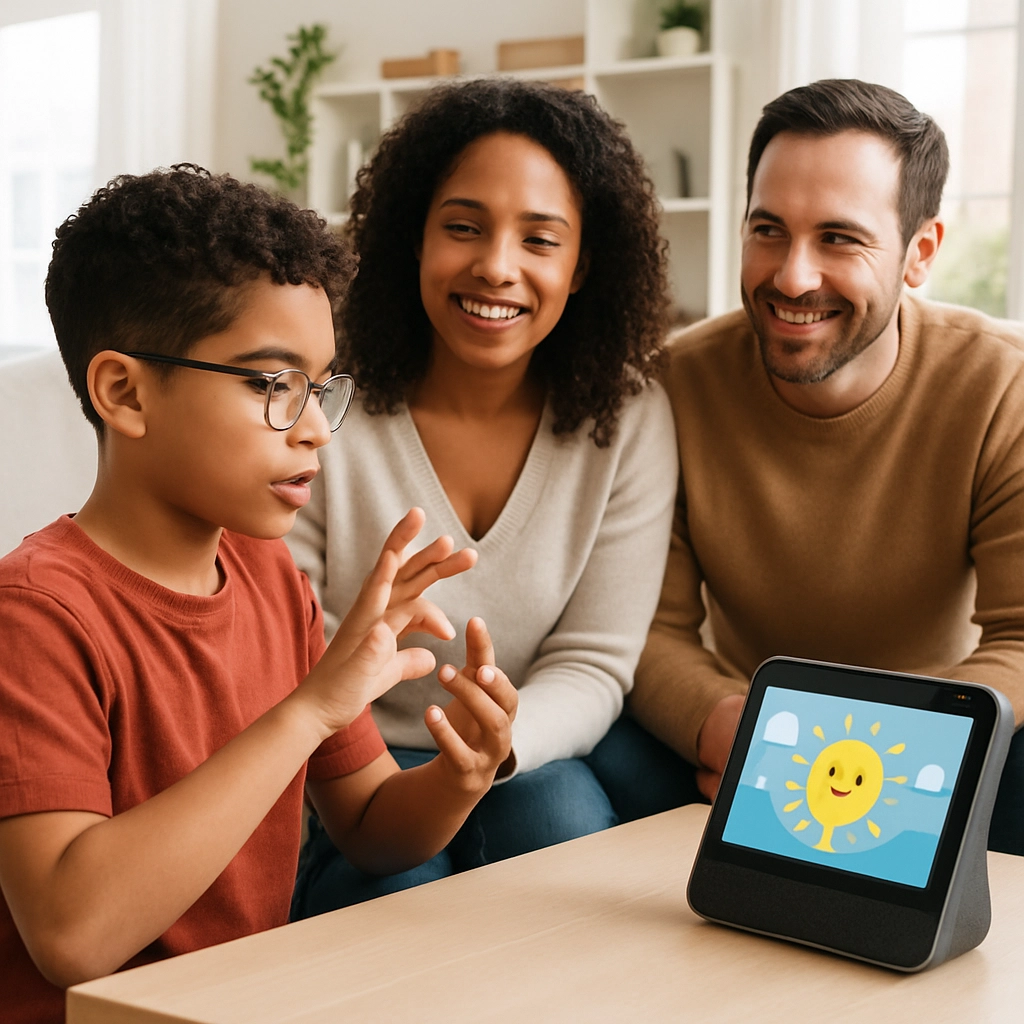
What would a sign-language-capable personal assistant actually do for a deaf or hard-of-hearing user? The possibilities are transformative. Consider the mundane but critical task of being alerted to household sounds. A device with visual understanding could detect a crying baby in another room, a smoke alarm, or a doorbell and flash a light or display a message saying “Alert: Smoke alarm detected in the kitchen.” This isn't just helpful; it's a safety-critical feature.
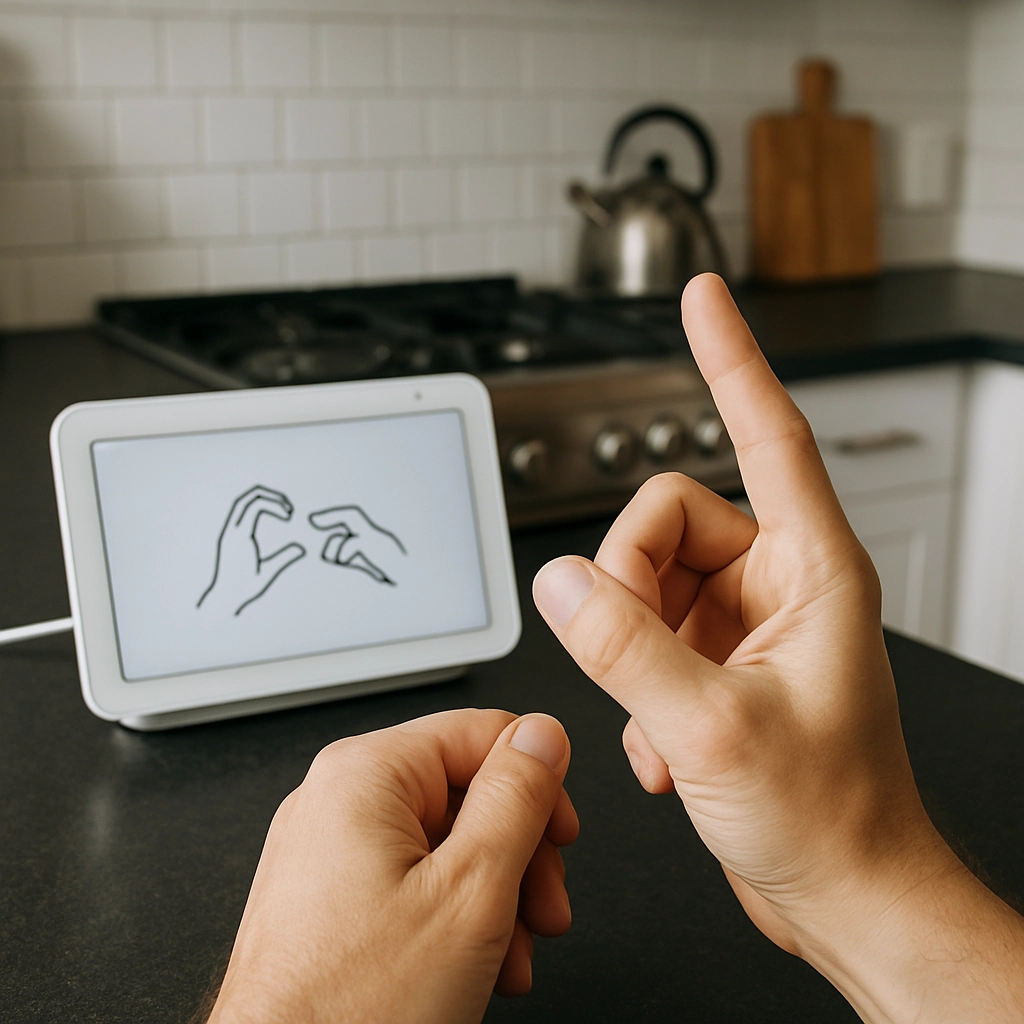
Beyond safety, imagine a deaf student in a kitchen trying to follow a complex recipe. Instead of fumbling with a phone or tablet, they could simply ask their assistant, in sign language: “Show me the next step.” The device, using its camera to recognize the signs, would then display the instructions on its screen. Or consider a deaf professional taking a hands-free video call. Their assistant could transcribe the conversation in real-time, allowing them to focus on signing back to the other participants. The device becomes not just an appliance but a communication bridge, a quiet and powerful ally that transforms the home environment from a potential source of isolation into a hub of seamless interaction.
Challenges and the Path Forward: Data, Diversity, and Design
The road to this future is paved with significant hurdles. The most immediate is data. While there are massive datasets for spoken English, datasets for sign languages are comparatively small and often lack diversity. Sign language is not universal; American Sign Language (ASL) is different from British Sign Language (BSL), which is different from Japanese Sign Language (JSL). Furthermore, within each language, there are regional dialects, varying speeds of signing, and unique personal styles. An AI trained on one narrow dataset will perform poorly in the real world.
To overcome this, Microsoft and other researchers are focusing on federated learning and community partnerships. The goal is to collect data ethically and consensually from the Deaf community, ensuring the resulting models are robust and representative. Another challenge is device hardware. The small cameras and limited processing power of many current personal assistant devices may not be sufficient for the complex video analysis required. Future devices will likely need specialized AI chips or rely more heavily on cloud computing to perform the necessary inference in real-time without draining battery life or compromising privacy.
Beyond the Smart Speaker: A Vision for a Truly Universal Interface
Ultimately, the quest to integrate sign language recognition into personal assistant devices is about more than a single product category. It is about redefining the paradigm of human-computer interaction. The real opportunity is to move beyond the binary of “voice or touch” and towards a truly universal interface that adapts to the user’s preferred mode of expression. By investing in this technology, companies like Microsoft are not just building a better smart speaker; they are laying the groundwork for a future where any person, regardless of their hearing ability, can interact with technology naturally and effortlessly.
This vision extends into the workplace, education, and social settings. The AI that learns to understand sign language at home can be applied to captioning video calls, improving accessibility in public kiosks, and even helping hearing individuals learn sign language themselves. It is a virtuous cycle where technology designed for one group benefits everyone. The “opportunity at home,” as Microsoft frames it, is not just about a single device in a single room; it is a proof-of-concept for an inclusive, accessible, and intelligent future for all.