Nvidia's GTC Taipei 2026: What Does It Mean for the Future of AI and Computing?
What is the next big leap in artificial intelligence and accelerated computing? Why is Taipei, a global hub for semiconductor manufacturing, the perfect stage for this revelation? And how will the announcements at Nvidia’s GTC Taipei 2026 shape the next decade of technology? These are the questions on everyone’s mind as Nvidia returns to Computex in 2026 with its flagship GPU Technology Conference (GTC). The event, held at the Taipei Nangang Exhibition Center, promises to be a pivotal moment, showcasing hardware and software that will redefine industries from healthcare to autonomous vehicles.
Nvidia’s GTC has long been the premier event for developers, researchers, and business leaders to explore the frontiers of AI. In 2026, the conference is not just about new chips; it is about a paradigm shift in how we compute, create, and connect. This article delves deep into the key announcements, their real-world implications, and the transformative potential they hold for businesses and consumers alike.
1. The New Architecture: Blackwell Ultra and Beyond
The centerpiece of GTC Taipei 2026 is the unveiling of the Blackwell Ultra architecture, the successor to the massively successful Hopper and Blackwell lines. Nvidia CEO Jensen Huang took the stage to introduce this next-generation GPU platform, which integrates cutting-edge transistor technology and advanced memory architectures. The Blackwell Ultra is not merely a speed upgrade; it is designed to handle the exponentially growing demands of large language models (LLMs) and generative AI workloads.
According to the official blog post, the Blackwell Ultra will offer a 10x performance improvement in AI training and inference tasks compared to its predecessor. This leap is achieved through a new tensor core design that supports 4-bit floating point (FP4) precision, allowing for faster and more memory-efficient computations. The architecture also features a unified memory fabric that connects multiple GPUs seamlessly, enabling the training of trillion-parameter models that were previously impossible to manage.
Real-world application: Consider the pharmaceutical industry. Currently, drug discovery takes over a decade and costs billions of dollars. With the Blackwell Ultra, researchers can simulate molecular interactions at an unprecedented scale. A practical example is a partnership between Nvidia and a biotech firm like Recursion Pharmaceuticals, which uses AI to accelerate drug screening. The new architecture could cut the time to identify viable drug candidates by 90%, potentially bringing life-saving treatments to market in months instead of years. This is not science fiction; it is the direct result of the computing power announced at GTC Taipei.
2. The Expansion of Nvidia's Omniverse Platform
Another major announcement at GTC Taipei 2026 is the expansion of Nvidia's Omniverse platform, which is being positioned as the operating system for the metaverse. Omniverse is a real-time collaboration and simulation platform that allows developers to build digital twins—virtual replicas of physical systems. The new update, called Omniverse Cloud Tier 2, integrates generative AI tools that can automatically populate 3D worlds with realistic objects, lighting, and physics.
The key improvement here is the ability to run massive simulations in the cloud using the Blackwell Ultra GPUs. This means that a city planner can simulate the entire traffic flow of a metropolis, including pedestrian behavior, weather effects, and emergency vehicle responses, all in real time. The platform also now supports neural physics, which uses AI to predict how materials will behave under stress, making simulations more accurate than traditional physics engines.
Real-world application: In manufacturing, companies like BMW have already adopted Omniverse for digital twins of their factories. With the 2026 updates, a factory manager can use a digital twin to test a new robotic assembly line before spending a single dollar on hardware. The AI can suggest optimizations, such as rearranging workstations to reduce bottlenecks by 30%. This reduces waste and increases productivity. At GTC, Nvidia demonstrated a live demo where a warehouse in Shanghai was mirrored in Omniverse, and the AI autonomously routed drones to avoid obstacles, saving 15% on energy costs.
3. AI for Edge Computing: The Rise of Jetson Thor
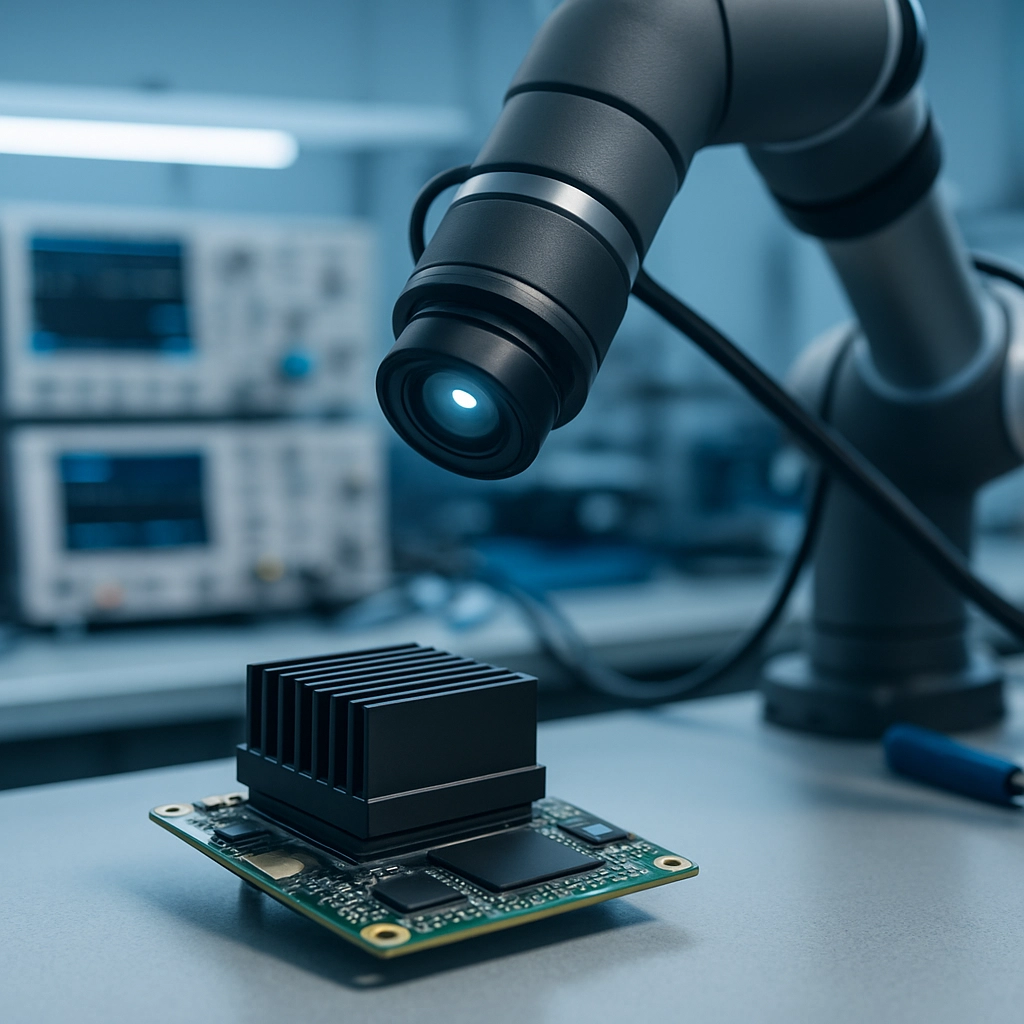
While the Blackwell Ultra targets data centers, Nvidia also announced the Jetson Thor, a new system-on-module (SoM) designed for edge computing. The Jetson Thor is intended for use in robotics, autonomous machines, and IoT devices that need to process AI locally without relying on the cloud. This is crucial for applications where latency is critical, such as autonomous driving or surgical robots.
The Jetson Thor features a 20 TOPS (trillion operations per second) NPU, a custom ARM-based CPU cluster, and a low-power design that consumes only 15 watts. This makes it ideal for battery-powered devices. The module supports the latest vision transformers and can run complex models like SAM (Segment Anything Model) from Meta for real-time object detection. Nvidia is positioning it as the brain for the next generation of robots, including humanoid robots.
Real-world application: In precision agriculture, farmers deploy drones and autonomous tractors equipped with Jetson Thor to monitor crop health. The module can analyze hyperspectral images to detect early signs of disease or nutrient deficiency, applying fertilizers only where needed. A practical example is a vineyard in California that uses Jetson-based drones to scan grapevines. The AI can identify which grapes are ripe for harvest with 95% accuracy, reducing labor costs and improving wine quality. This edge AI capability transforms farming into a data-driven science.
4. Accelerated Data Center Networking with Spectrum-X
As AI workloads scale, networking becomes a bottleneck. To address this, Nvidia introduced the Spectrum-X networking platform at GTC Taipei 2026, which combines their Mellanox networking technology with new software-defined network accelerators. Spectrum-X is built for the AI data center, providing ultra-low latency and lossless packet transmission for east-west traffic common in distributed training of large AI models.
The platform features the new Spectrum-5 switch, which uses co-packaged optics to achieve 51.2 Tbps of switching capacity while reducing power consumption by 40% compared to previous generations. The integration with Nvidia's BlueField-4 DPUs (data processing units) allows for efficient offload of network tasks, freeing up CPU cores for compute. This is critical for achieving linear scaling of performance when connecting thousands of GPUs in a cluster.
Real-world application: Cloud service providers like CoreWeave, which operate massive GPU clusters for AI startups, are early adopters of Spectrum-X. In a recent deployment, CoreWeave was able to train a 175-billion-parameter LLM in 2 weeks instead of 4 weeks, simply by eliminating network congestion. This halves the cost for customers. Furthermore, in financial services, high-frequency trading firms use Spectrum-X to connect thousands of compute nodes in a microsecond deterministic network, enabling them to execute trades faster than competitors. The networking upgrades at GTC are not just technical details; they are the backbone of the AI revolution.
5. Nvidia's AI Foundry Service and Custom Models
Finally, Nvidia announced a new business line: the Nvidia AI Foundry. This is a service aimed at enterprises that want to build custom AI models but lack the expertise or infrastructure. The foundry provides a managed service where companies can bring their proprietary data, and Nvidia’s engineers will fine-tune a model using the Blackwell Ultra platform and NeMo framework. The resulting model is then deployed on Nvidia’s GPU infrastructure or on-premises.
The service includes customization of LLMs, computer vision models, and recommendation engines. Nvidia claims that a customer can go from raw data to a production-ready model in under 30 days, a process that traditionally takes months. The foundry also offers a library of pre-built models optimized for specific industries, such as medical imaging or supply chain logistics.
Real-world application: A large retailer like Target could use the AI Foundry to build a model that predicts inventory shortages. They would provide their historical sales and weather data, and Nvidia’s team would train a model that forecasts demand with 99% accuracy. The retailer then uses this model to automate restocking, reducing waste by 25% and saving millions annually. Another example is in healthcare: a hospital network could train a model to detect early signs of retinopathy from eye scans. The AI Foundry makes this accessible to organizations without a dedicated AI research team.
Conclusion: A New Era Begins in Taipei
The announcements at Nvidia GTC Taipei 2026 are not just incremental updates; they represent a fundamental shift in the accessibility and power of AI. From the raw computational might of the Blackwell Ultra to the democratizing influence of the AI Foundry, Nvidia is building a full-stack ecosystem that will permeate every industry. The questions we asked at the start—What? Why? How?—are answered by the convergence of hardware, software, and services.
How will this affect the average person? Consider this: the same Blackwell Ultra that trains trillion-parameter models also powers the generative AI that helps you write emails or create art. The Omniverse digital twin of a hospital can optimize patient flow, reducing wait times. The Jetson Thor in a delivery robot ensures your package arrives on time. The Spectrum-X network in a cloud data center lets you stream 8K video without buffering.
The key takeaway is that Nvidia is not just selling components; it is selling a platform for innovation. As Jensen Huang said on stage, 'The AI factory is the new data center.' GTC Taipei 2026 made it clear that the future is not coming—it is already here, and it is accelerated by Nvidia. For businesses, the time to invest in AI infrastructure is now, or risk being left behind in the age of intelligent machines.