Cutting AI Search Costs: What, Why, and How to Optimize Your Spend
What if your AI search system is silently draining your budget? Why are AI search costs skyrocketing, and how can you reduce them without sacrificing quality? In today's digital era, artificial intelligence-powered search is integral to user experience, powering everything from e-commerce recommendations to enterprise knowledge bases. However, the computational and financial resources required to maintain these systems can be staggering. This article dives deep into the strategies for slashing AI search costs while maintaining high accuracy and performance, drawing from the latest insights at The New Stack.
AI search is not merely about returning results; it involves complex language understanding, retrieval-augmented generation (RAG), and vector database queries. These processes incur significant costs—from API calls to cloud compute and storage. Understanding the mechanics behind this expense is the first step toward optimization. We will explore the core challenges, practical solutions, and real-world examples that can help businesses of all sizes streamline their AI search operations.
Understanding the Cost Drivers in AI Search
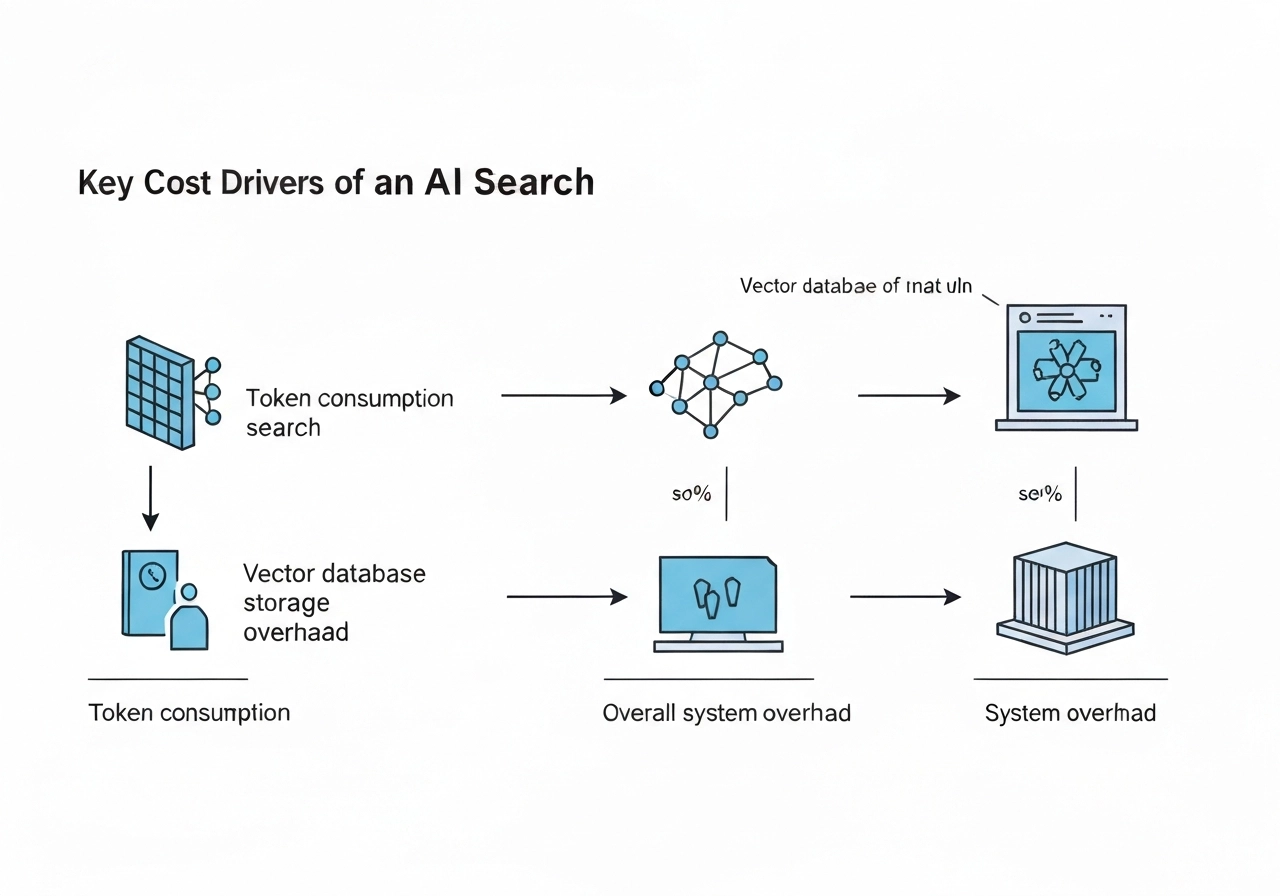
To cut costs, one must first identify where the money goes. AI search systems—particularly those built on large language models (LLMs) and retrieval systems—have several primary cost centers. The most obvious are the compute resources needed to run inference: each search query that hits an LLM incurs a token cost, which scales linearly with query length and complexity. Additionally, vector databases charge based on the number of stored vectors and the frequency of queries. Sparse and dense retrieval methods also consume storage and processing power.
Token Consumption and API Fees
Every interaction with an AI model, especially with APIs like OpenAI's GPT or Google's Gemini, is metered by tokens. A token is roughly 0.75 words, and the cost per token can add up quickly. For instance, a typical search application might process thousands of queries per day—each requiring both input (user query + context) and output (generated response) tokens. Without careful management, monthly API bills can exceed five figures.
Vector Database and Storage Overhead
Modern AI search relies heavily on vector embeddings representing document meaning. Storing these vectors in databases like Pinecone, Weaviate, or Chroma introduces costs per vector and per operation. As your document corpus grows, so does the memory footprint. Moreover, updating embeddings when documents change triggers re-indexing—a process that consumes both compute time and money.
Real-world example: An e-commerce company saw its monthly AI search costs jump from $2,000 to $15,000 after scaling from 10,000 products to 500,000. The primary factors were the tripling of vector storage and a fourfold increase in API calls for query rewriting before search.
Strategic Optimization: Chunking, Caching, and Context Management
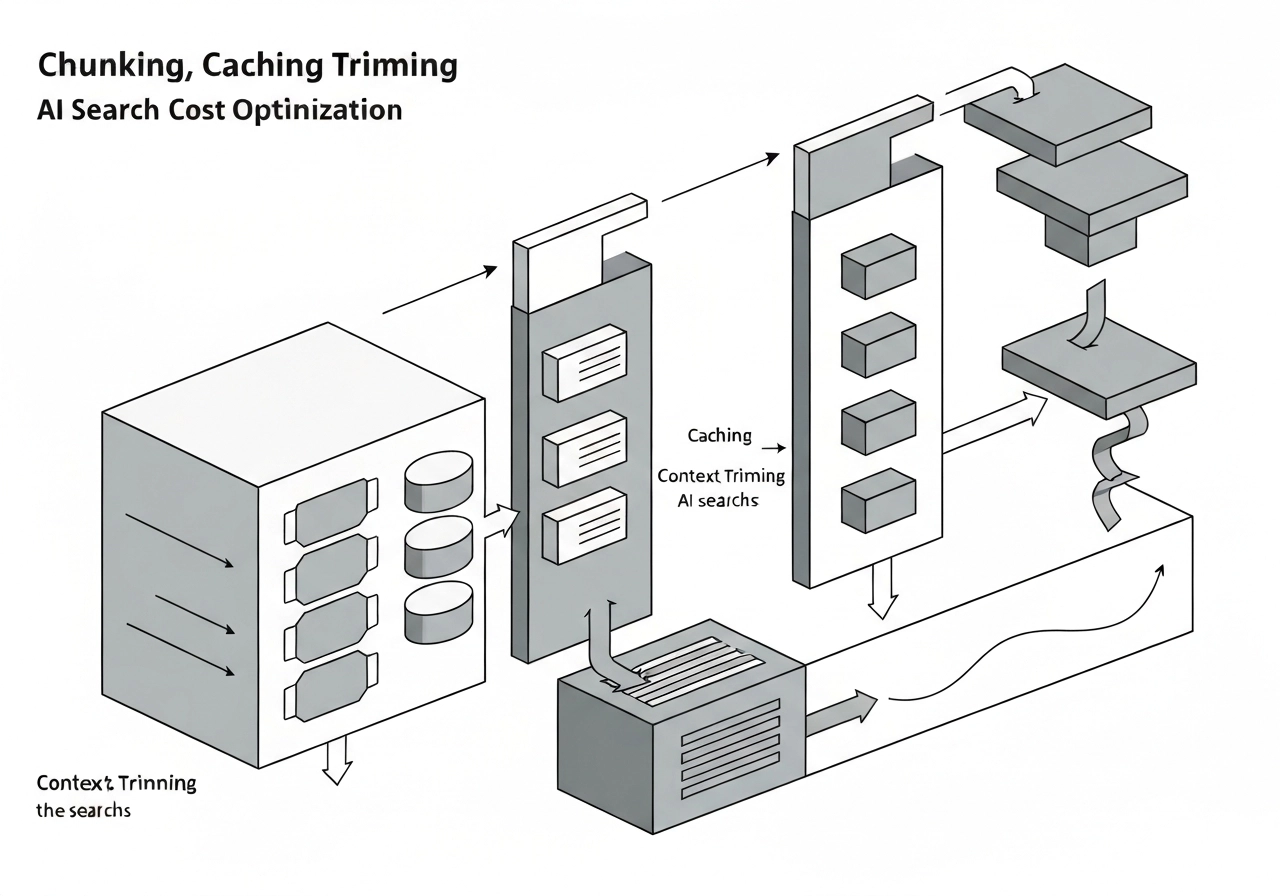
Once you understand the cost drivers, the next step is to implement targeted optimizations. Three of the most effective levers are document chunking, result caching, and intelligent context trimming. These methods directly reduce the number of tokens processed per query and the frequency of expensive operations.
Document Chunking: Smaller Pieces, Lower Cost
Rather than processing entire documents as single embeddings, split them into smaller, semantically coherent chunks. This not only improves retrieval accuracy but also reduces the amount of text sent to the LLM for each answer generation. For example, a 10-page legal document might be chunked into 20 paragraphs. When a user searches for a specific clause, only the relevant chunk—representing maybe 5% of the total document—is passed to the LLM. The result? A dramatic cut in token consumption, sometimes by over 80%.
Aggressive Caching of Frequent Queries
Most AI search systems handle a long tail of unique queries, but the top 20% of queries often account for 80% of traffic. By implementing a caching layer that stores both the generated answers and the retrieved chunks for these frequent queries, you can bypass the LLM entirely for repeat requests. Caching can reduce API costs by 40–60% in consumer-facing applications, according to industry benchmarks. Technologies like Redis or in-memory solutions with TTL (time-to-live) policies are ideal for this.
Context Window Management: Trim the Fat
LLMs have fixed context windows (e.g., 8K or 32K tokens). Feeding extraneous context not only costs money but degrades performance. Implement smart context pruning: send only the top-N retrieved chunks that match the query intention, and use metadata filtering to drop irrelevant sections. For example, in a customer support knowledge base, if a user asks about “refund policy,” you should retrieve only the refund-related chunks, not the entire FAQ section. This focus reduces per-query costs by 30–50%.
Practical application: A health tech startup reduced its monthly OpenAI bill from $12,000 to $4,500 by chunking all medical literature into 200-token fragments, caching the 500 most common patient queries, and trimming context to exactly three relevant chunks per answer. The system maintained 97% accuracy in answering patient questions.
Advanced Techniques: Model Selection and Hybrid Search
Beyond the low-hanging fruit of chunking and caching, deeper architectural changes can yield substantial long-term savings. Two powerful approaches are choosing cost-efficient models and implementing hybrid search that balances speed and accuracy.
Smaller, Specialized Models vs. Giant Models
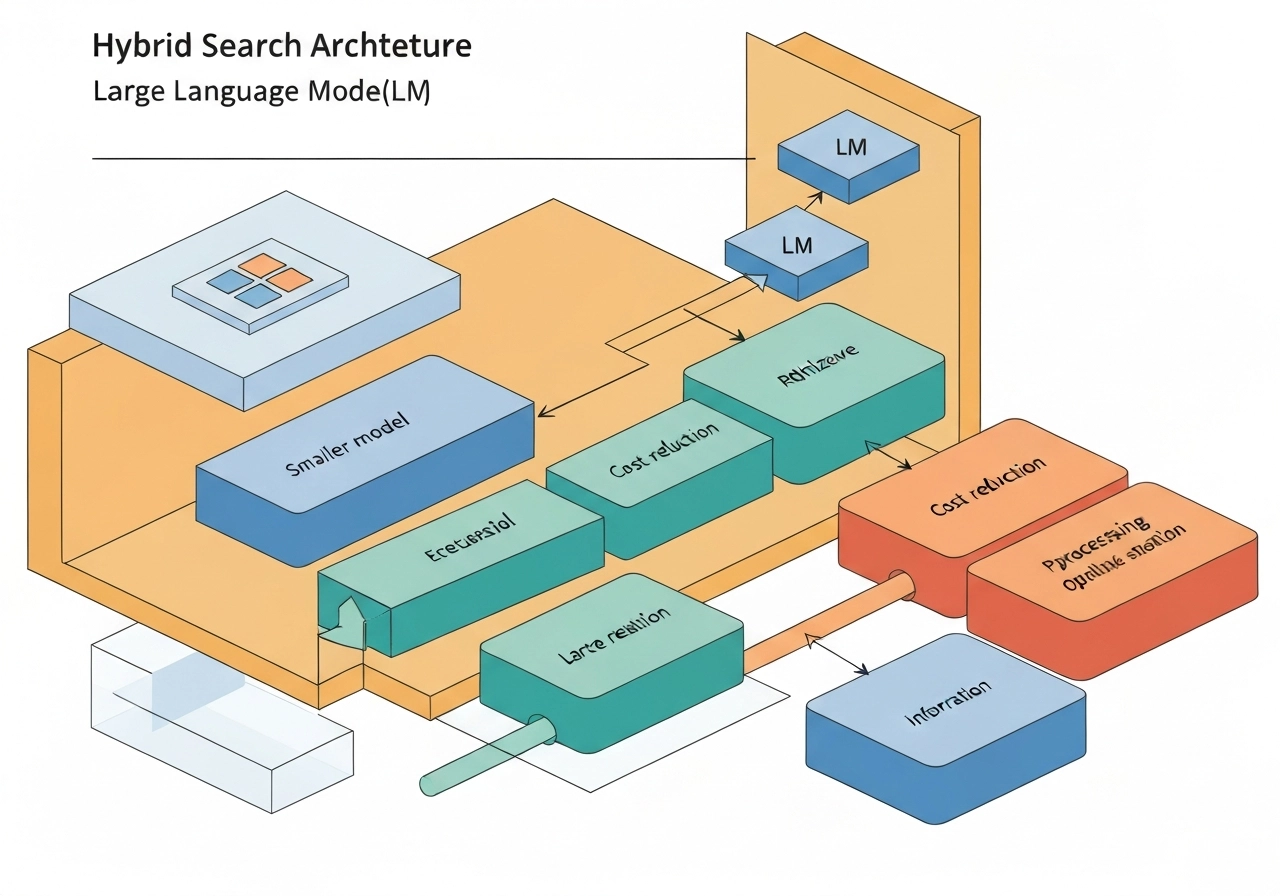
Not every search query requires the cognitive power of GPT-4 or Claude 3. For many tasks—like re-ranking retrieved results, summarizing simple facts, or generating short descriptions—smaller models (e.g., GPT-3.5, Mistral 7B, or fine-tuned T5) deliver near-equivalent quality at a fraction of the cost. Consider using a router system: a lightweight classifier first assesses query complexity; simple queries go to a cheap model, while complex ones escalate to a premium model. This tiered approach can cut overall model costs by 50–70%.
Hybrid Search: Sparse + Dense Retrieval
Pure dense vector search with LLMs is expensive. A hybrid approach combines traditional keyword-based search (like BM25) with dense vector embeddings. The keyword search handles exact match terms efficiently, while vector search covers semantic similarity. This reduces the number of times you need to query the LLM for re-ranking, as the initial retrieval set is already highly relevant. Hybrid search also decreases the load on vector databases, potentially cutting infrastructure costs by 30%.
Real-world example: A legal research platform switched from a pure LLM-based search to a hybrid system using BM25 for statute lookups and dense vectors for case law similarity. The change reduced their total compute costs by 45% while improving search speed by 200 milliseconds per query. Users reported equivalent satisfaction.
Infrastructure and Data Management Efficiency
Cost optimization is not only about the AI layer; the underlying infrastructure and data management practices play a colossal role. By right-sizing your compute resources, choosing the right database, and maintaining data hygiene, you can achieve savings that complement algorithmic improvements.
Right-Sizing Compute and Storage
Cloud instances for inference and vector ingestion must be chosen carefully. Over-provisioning leads to wasted spend; under-provisioning causes slow responses. Use auto-scaling groups that spin up additional CPU/GPU resources only during peak hours. For vector databases, choose a service that supports tiered storage: hot storage for frequently accessed vectors, cold storage for archival data. This can cut storage costs by 60%.
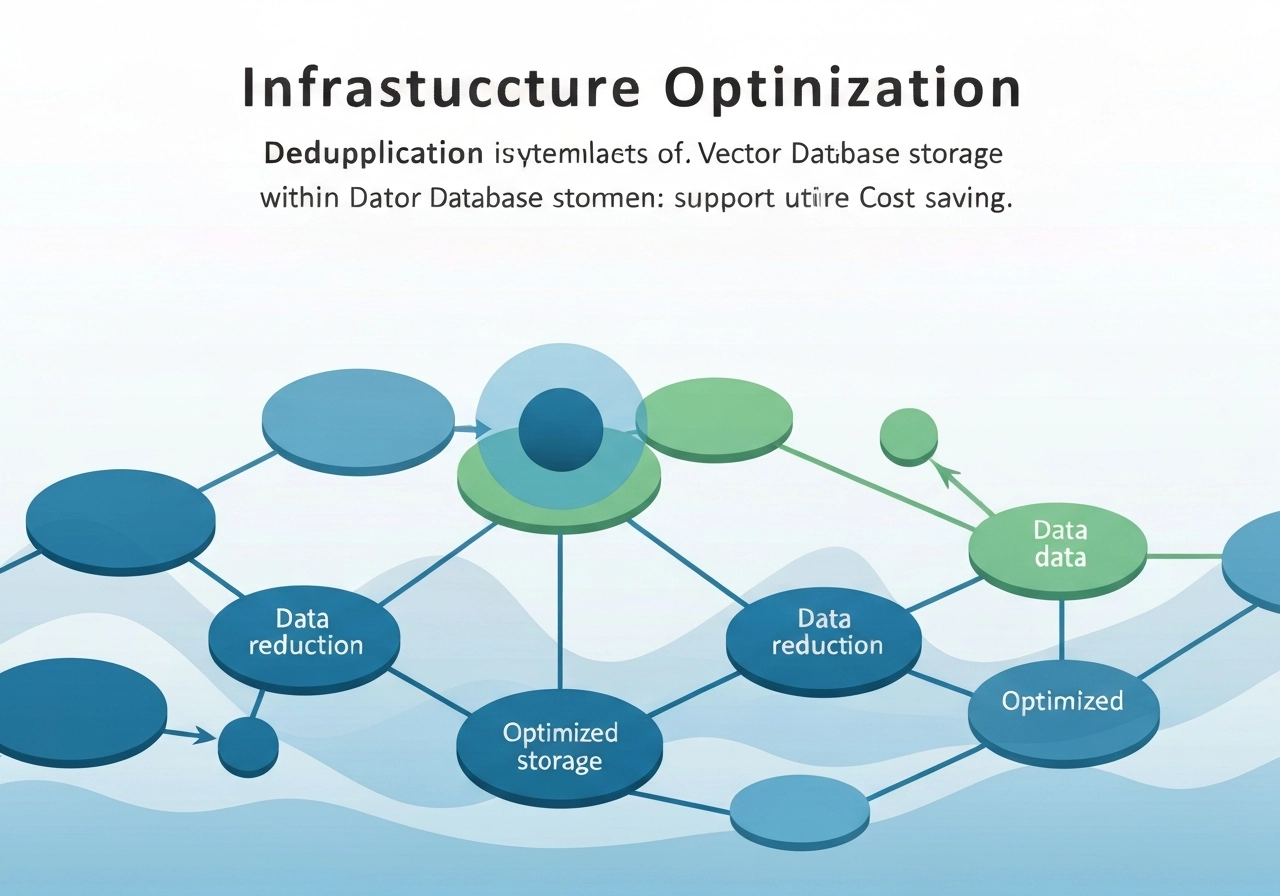
Data Deduplication and Indexing Hygiene
Duplicated documents or outdated embeddings inflate storage and processing costs. Implement regular deduplication pipelines that remove duplicate content. Also, prune embeddings for documents that are seldom accessed. By keeping a lean, clean index, you reduce the number of vectors queried and the memory footprint. Many teams ignore this, but a one-time cleaning can slash vector count by 20–30%.
Practical application: A media company with a library of 2 million articles found that 15% of their vectors were duplicates or near-duplicates. After deduplication and moving 30% of old articles to cold storage, they reduced their vector database bill from $8,000 to $3,400 per month—a 57% saving—without any loss in search quality.
Monitoring, Measurement, and Continuous Improvement
Cost reduction is not a one-time activity but an ongoing process. To sustain savings, you must instrument your AI search system with detailed cost tracking, set guardrails, and regularly audit performance vs. expenditure.
Implementing Cost Baselines and Dashboards
Start by setting a cost baseline per query or per user session. Use logging frameworks to capture tokens consumed, compute time, and database operations for each search. Dashboards built with tools like Grafana or Datadog can track cost trends, alerting you to spikes. For example, a sudden increase in average token usage per query might indicate a chunking misconfiguration or a change in user behavior. Once you identify anomalies, you can investigate and fix them promptly.
Automated Budget Policies
Set hard limits on daily or monthly spending for the AI search module. Use API throttling to cap query rates during non-critical times. Some cloud providers allow you to define “cost budgets” that trigger alerts or even shuts down non-essential models when exceeded. This prevents unexpected bills from exceeding your allocated budget.
A/B Testing Optimization Strategies
Before rolling out any cost-saving change—like switching to a smaller model or reducing chunk size—run A/B tests comparing the current system with the optimized version. Measure not only cost per query but also user engagement metrics like click-through rate, time to answer, and user satisfaction scores. This ensures that cost savings do not come at the expense of quality. Over time, you can iterate on the trade-offs.
Real-world example: A SaaS company implemented a monthly cost review cycle. They discovered that after deduplication, average query cost dropped by 25%, but user satisfaction dipped slightly. By fine-tuning their re-ranking model, they recovered satisfaction while still maintaining a 20% net cost reduction. Continuous monitoring made this adjustment possible.

Conclusion: The Path to Sustainable AI Search
Cutting AI search costs is not about compromising quality—it's about intelligently reducing waste. We have explored the major cost drivers, from token consumption to vector storage, and provided a toolkit of practical strategies: chunking, caching, model selection, hybrid retrieval, infrastructure tuning, and vigilant monitoring. Each of these measures can yield significant savings when implemented correctly.
As AI continues to evolve, the cost landscape will shift, but the principles remain: measure everything, optimize iteratively, and balance cost with user experience. Businesses that master these techniques will not only save money but also build more scalable, responsive search systems. Start today by auditing your current AI search stack. Identify the biggest cost centers and apply one or two of the strategies outlined here. Even a 20% reduction can translate into thousands of dollars saved annually.
The journey to cost-effective AI search is ongoing. With the right mindset and tools, you can deliver exceptional search experiences without breaking the bank.